

Source: Shutterstock
What Institutional Investor Should Monitor in 2026
Oil prices moving up is not the real story. The real story is that energy supply routes are becoming fragile again — and markets are starting to price that risk. When key shipping routes like the Strait of Hormuz face disruption risk, oil doesn’t just become more expensive. It becomes more unpredictable. And unpredictability is what markets reprice.
Why This Matters: One Simple Idea
About 20% of global oil flows through the Strait of Hormuz. That’s a lot.
If even a small disruption happens:
- Shipping costs rise
- Insurance costs rise
- Delivery times increase
- Oil price volatility jumps
Even if the route does not close, markets price the risk that it could. That extra cost is what we call the ‘resilience premium’ the price markets pay for uncertainty.
Oil Price Is Not the Only Cost
Investors often focus on Brent crude. But countries and companies don’t pay just the oil price. They pay:
- Oil price + Shipping + Insurance + Delays
For large oil-importing countries, this affects:
- Inflation
- Currency stability
- Interest rate decisions
- Trade balances
This is where it becomes a portfolio issue.
How Energy Risk Moves Markets
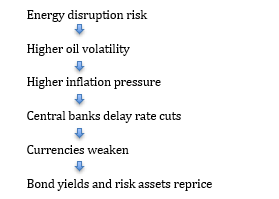
This is not just about commodities. It affects bonds, equities, and FX
What Could Happen?
Instead of predicting oil prices, it’s better to think of scenarios.
Scenario 1: Tension But No Disruption
- Oil volatile but stable supply
- Inflation manageable
- Markets adjust gradually
Scenario 2: Partial Disruption
- Shipping costs jump
- Insurance premiums rise
- Inflation surprises on the upside
- EM currencies weaken
Scenario 3: Sustained Disruption
- Oil spikes sharply
- Global risk-off
- Central banks pause easing
- Cross-asset volatility increases
Smart institutions prepare for all three — not just the base case.
What Investors Should Monitor
Instead of reacting to headlines, monitor these:
| What to Watch | Why It Matters |
| Oil above $85 | Inflation sensitivity increases |
| Oil volatility rising sharply | Risk budgets may need adjusting |
| Shipping disruptions in Hormuz | Physical supply constraint risk |
| Trade deficits widening | Currency pressure building |
| Inflation expectations rising | Central bank flexibility shrinking |
If two or more of these worsen together, risk management needs adjustment. Simple. Structured. Actionable.
Our View: Energy Flexibility Is Becoming a Competitive Advantage
For years, markets assumed energy shocks were temporary, supply would reroute, prices would normalize, and volatility would fade. That assumption is now weakening.
Geopolitical tensions, trade disputes, and fragile shipping routes mean energy risk may stay elevated for longer.
The real issue is not whether oil goes to $90 or $95. The real issue is whether economies and portfolios have flexibility.
Countries with:
- Diverse supply sources
- Strong currency reserves
- Policy credibility
Will handle shocks better.
Portfolios with:
- Balanced energy exposure
- Inflation protection
- FX hedging
Will outperform in volatile regimes.
Source: www.thehindu.com